
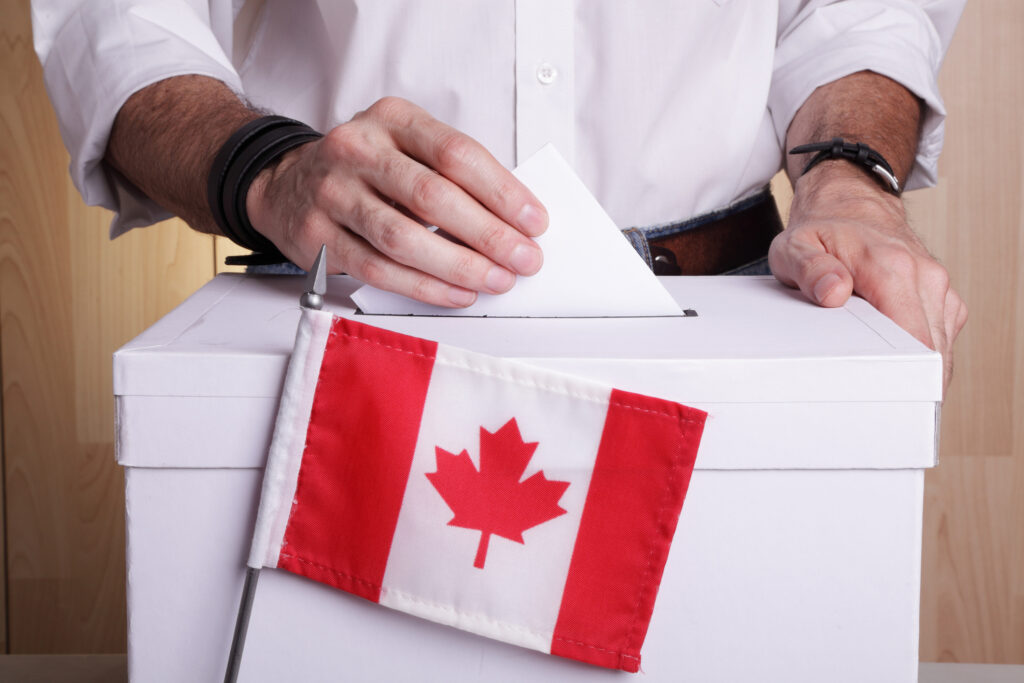
First-Past-The-Post Voting System
Federal elections take place roughly every five years in Canada. The Canadian election operates through a single member plurality system or First-Past-the-Post (FPTP), where each voter is allowed to vote for only one candidate, your local Member of Parliament. The winner of your local riding is the candidate that received more votes than all the other candidates.
In a FPTP voting system candidates can win with less than 50% of the votes as long as the candidate wins more votes than the other candidates. Additionally, critics argue that voters vote for the candidate that can beat the candidate they don’t want to win instead of voting for the candidate they want to vote for.
Voting
Canadians have the right to vote, protected by section 3 of the Charter.
You can vote if you:
- Are a Canadian citizen
- Are at least 18 years old on election day
- Are a resident in the riding
Find assigned advance and election day polling places using Voter Information Service.
How to Register to Vote
1. Online
- Use the Online Voter Registration Service to register or update address
2. In person
- Register and vote at local Elections Canada office
- Can register at assigned polling station when you go to vote on advance polling days or on election day
3. Am I registered?
- Registered voters receive a voter information card in the mail. The card confirms you are registered, it also tells where and when you vote.
- Check online to see if you’re registered
Identification
When you go vote, you need to bring identification. The following are the options for identifications you can bring.
Option 1: Show Driver’s license or other card issued by Canadian (federal, provincial or local) government with photo, name and current address
Option 2: Show two pieces of ID (both must have name and one must have current address)
- Here is a list ID that can be used
Option 3: If you don’t have ID
- Declare identity and address in writing and have someone who knows you and is assigned to your polling station to vouch for you
- Voucher must be able to prove identity and address
- A person can vouch for only one other person
How to Vote
1. Vote in person
Voters can vote in person on election day, or on advance voting days. They can also go vote at an Elections Canada before election day and not on advance voting days. In order to vote, voters need to bring proof of identification. Voters make a mark beside the name of the candidate they wish to vote for.
2. Vote by mail (special ballot voting)
For any voter who cannot or does not want to vote at an advance or election day poll. Also for voters who are away from their riding. In order to vote, the voter has to write the first and last name of the candidate they’re voting for instead of choosing from a list. You can drop the envelope in a ballot box at the Elections Canada office. If you’re voting by mail, follow the instructions that you received with your voting kit, and return your ballot using the pre-addressed return envelope. Make sure that Elections Canada receives ballots by election day at 6 pm. Apply for a special ballot by visiting the local Elections Canada office or mailing/faxing paper application or Apply Online.
Role of Elections Canada
Elections Canada is a non-partisan independent agency to run federal elections, by-eletions and referendums. The head of Elections Canada is the Chief Electoral Officer who is not allowed to vote in federal elections. The Officer reports to Parliament, making them independent from the influence of the Prime Minister. The Chief Electoral Officer can be removed by the Governor General.