

Structure and Significance
The Constitution
The constitution is the supreme law of the country (as stated in Section 52 of the Constitution Act of 1982) that establishes the framework of government and defines its powers and limits. The drafters of the constitution designed it to ensure a strong federal government while also respecting provincial autonomy. Any law inconsistent with the Constitution is not applicable.
The constitution includes both written documents and unwritten conventions that draw heavily on British and American influences. Specifically, it blends the parliamentary traditions of the United Kingdom with the federalism structure adopted by the United States.
Key Components of the Constitution
Canada’s Constitution consists of:
- The Constitution Act, 1867
- The Constitution Act, 1982
- Unwritten Conventions
1. The Constitution Act, 1867
Formerly known as the British North America Act, 1867, this act created the Dominion of Canada by uniting Ontario, Quebec, New Brunswick, and Nova Scotia. It established the federal system, which divides government powers between federal and provincial levels (academically referred to as the ‘Division of Powers’). Accordingly, it set out federal and provincial jurisdictions and powers under Sections 91 and 92.
The act also outlined and defined the structure of Parliament to consist of the House of Commons, the Senate, and the judiciary.
2. The Constitution Act, 1982
This is historically recognizable for its picture of former Prime Minister Pierre Trudeau and Queen Elizabeth II. More specifically, this act patriated the Constitution and made Canada fully independent from the United Kingdom.
The Constitution Act of 1982 also recognized Aboriginal and treaty rights under Section 35, including that of First Nations, Inuit, and Métis. The section reflects reconciliation efforts between the Canadian government and Indigenous peoples. It is meant to protect Indigenous rights by addressing historical wrongs and guide future interpretations to advance reconciliation.
Additionally, the act introduced an amending formula, which outlines how the Constitution can be changed. The general amending formula currently requires the approval of Parliament and at least 7 provinces that represent 50% of the Canadian population.
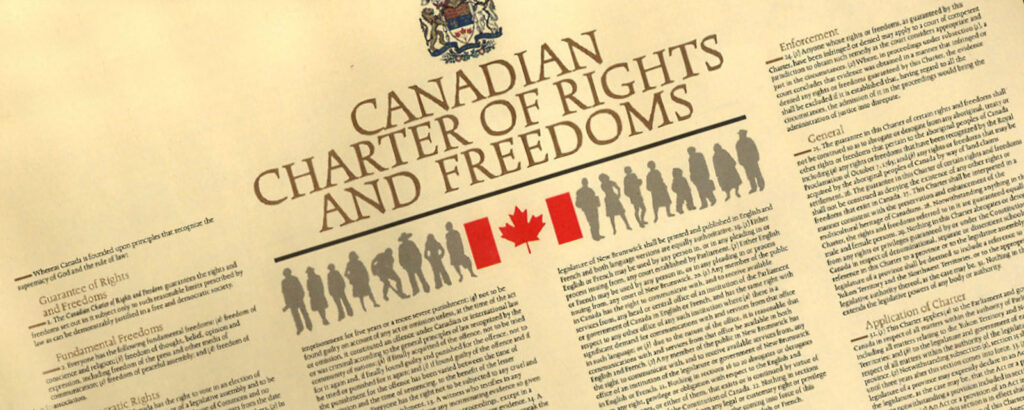
Finally, the act introduced the Canadian Charter of Rights and Freedoms. Often referred to as the Charter, the document guarantees civil and political rights and freedoms for all Canadians against government infringement. The Charter applies to federal, provincial and territorial governments across Canada.
3. Unwritten Conventions
Unwritten conventions are widely accepted historical practices and customs that are fundamental to Canadian governance and part of the constitutional framework, even though they are not formally written in the law or the Constitution. Inherited from the British, these conventions fill gaps in formal legal structures to allow for smooth governance. Conventions are not enforceable in court but are politically binding. Meaning, breaking them can lead to political crises or loss of confidence in government.
An example of a convention relates to the role of the Governor General. While the Governor General acts as the Queen’s representative to formally hold and exercise executive power, they typically do so on the advice of the Prime Minister and Cabinet by convention. This includes when to dissolve Parliament and who to appoint as Cabinet ministers.
Separation of Powers
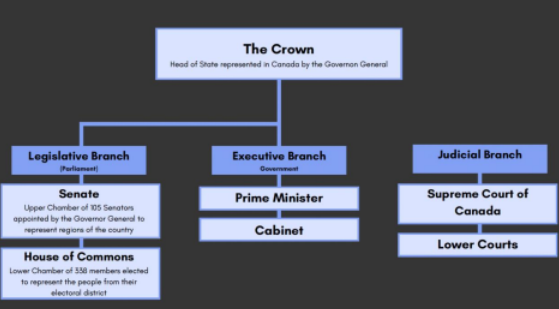
The principle of ‘separation of powers’ divides the responsibilities of governance among three branches: legislative, executive, and judicial. Each branch has its own roles, powers and limitations to ensure that no single branch becomes too powerful.
There are three branches:
- The Legislative Branch
- The Executive Branch
- The Judicial Branch
1. The Legislative Branch
The role of the legislative branch is to make and pass laws, approve budgets, and oversee the executive branch. It consists of Parliament, which includes the House of Commons and the Senate. Together, they form the bicameral legislature (meaning there are two chambers) to play distinct yet complementary roles.
a. House of Commons
The House of Commons is the lower chamber of Parliament. It is the predominant forum for political debate and lawmaking. The sitting members hold the government accountable through debates, Question Period, and committee work. The House of Commons decides on the budget for spending, outlining how taxpayers money is being spent.
Members who sit in the House of Commons are referred to as Members of Parliament (MPs). They are elected in federal elections. Currently, there are 343 MPs, each of whom is elected to represent one federal electoral district or riding across the country. They are to represent their constituents’ interest and concerns as an MP. They also hold the government accountable by providing alternative perspectives and participating in debates.
b. Senate
The Senate is also referred to as the upper chamber of Parliament that provides a ‘sober second thought’ to the House of Commons. They ensure that laws are fair, reasonable, and regionally inclusive.
Senators sit in the Senate and they are appointed by the Governor General on the advice of the Prime Minister. Currently, there are 105 Senators, all of whom can serve until the mandatory retirement age of 75 years. The seats are distributed to regionally ensure balanced representation.
Some of their duties involve:
- Reviewing legislation
- Ensuring regional representation especially for smaller provinces
- Advocating for minority or marginalized communities
| Feature | House of Commons | Senate |
|---|---|---|
| Membership | 343 elected MPs | 105 appointed Senators |
| Selection Method | Elected by voters | Appointed by the Governor General |
| Primary Role | Lawmaking and governance | Reviewing and revising laws |
| Accountability | Directly accountable to voters | Not directly accountable |
| Legislation Initiation | Most bills start here | Can start bills here, but usually do not |
2. The Executive Branch
The executive branch implements and enforces laws, conducts foreign relations, and commands the armed forces. Actors within this branch include the Prime Minister and the Cabinet.
a. The Prime Minister
The Prime Minister (PM) is the head of government and the most powerful political figure. They are responsible for leading the executive branch and making policy decisions. They are usually the leader of the political party that wins the most seats in the House of Commons after a federal election.
They serve many roles, including:
- Oversee the federal government and set overall direction and policies
- Chair Cabinet meetings and coordinate work of ministers
- Recommend appointments for Cabinet, Senators, and Judges of the Supreme Court of Canada.
- Parliamentary role in leading the ruling party in the House of Commons
- Representation of Canada in international forums and negotiations, such as G7, G20 and the United Nations
- Symbolic leadership in serving as face of the government and Canada to address national issues and crises
b. Cabinet
The Cabinet is a body of ministers chosen by the Prime Minister to lead federal departments and agencies. They implement government policies and administer public services. The members are chosen from the same party the PM belongs to. They oversee specific portfolios including finance, health, defense, or foreign affairs. Typically, the PM attempts to account for regional, gender and cultural diversity in the appointments.
Cabinet proposes and debates policies that govern Canada by introducing them in Parliament and overseeing their implementation. They meet regularly to discuss and decide key government priorities and strategies. The meetings themselves are kept confidential to allow open debate among ministers. Cabinet decisions are made collectively, and all ministers are expected to publicly support them. Personal opinions or objections can be raised during the confidential meetings.
3. The Judicial Branch
The judicial branch interprets and applies the law by determining its constitutionality, resolving disputes, and administering justice. The structure includes the Supreme Court and lower courts. Judges are appointed by the executive and legislative branches of government.
This branch includes the Supreme Court of Canada, the highest court in the country and Federal courts such as the Federal Court of Appeal which deal with cases that involve federal law and other disputes like tax disputes.
Division of Powers
The Constitution Act of 1867 sets out federal and provincial jurisdictions and powers under Sections 91 and 92. This is known as the ‘division of powers’ as it indicates which level of government (federal or provincial) has legislative authority to legislate in a particular area. For example, provincial governments are responsible for education while the federal government has the responsibility to oversee the military.
Overview of the Powers
| Federal Government | Provincial Government |
|---|---|
|
|
Difference between Division of Powers and Separation of Powers
| Federal Government | Provincial Government | |
|---|---|---|
| Definition | Dividing of power between federal and provincial (s.91 and s.92 of CA 1867) Refers to which level of government (federal or provincial) has the legislative competency to legislative in a particular area |
Refers to the branch of government is responsible for the exercise of a particular type of power |
| Who has the power? | Federal or Provincial | Legislative, judiciary and executive |
| What sort of power? | Power to enact statutes and laws | Legislative: Power to enact statutes and laws, supervising budget and expenditure of funds, debating issues of the day
Judiciary: makes judgment, determine findings of fact and law, historical determinations Executive: makes regulations, determination, administrative |
Charter of Rights and Freedom
Often referred to as the Charter, the document guarantees civil and political rights and freedoms for all Canadians against government infringement. The Charter applies to federal, provincial and territorial governments across Canada.
Key features of the Charter include:
Limitation Clause (Section 1)
- Allows reasonable limits on rights and freedoms, provided they can be justified in a free and democratic society
- Courts use the Oakes Test to determine if a limitation is justified
Fundamental Freedoms (Section 2)
These are basic freedoms essential to a democratic society:
- Freedom of conscience and religion
- Freedom of thought, belief, opinion, and expression (including freedom of the press)
- Freedom of peaceful assembly
- Freedom of association
Democratic Rights (Sections 3-5)
These rights ensure participation in the democratic process:
- The right to vote in federal and provincial elections
- The right to run for public office
- Mandates that Parliament and legislatures sit at least once a year
- Limits the maximum duration of legislatures to five years, except in emergencies
Mobility Rights (Section 6)
- Citizens have the right to enter, remain in, and leave Canada
- Citizens and permanent residents can move and work in any province, subject to reasonable residency requirements (e.g., for social services)
Legal Rights (Sections 7-14)
Protect individuals in their dealings with the justice system:
- Section 7: Right to life, liberty, and security of the person
- Section 8: Protection against unreasonable search and seizure
- Section 9: Protection against arbitrary detention or imprisonment
- Section 10: Rights upon arrest or detention (e.g., to be informed of charges, to consult a lawyer)
- Section 11: Rights in criminal proceedings (e.g., presumption of innocence, trial within a reasonable time)
- Section 12: Protection from cruel and unusual punishment
- Section 13: Protection against self-incrimination
- Section 14: Right to an interpreter in court
Equality Rights (Section 15)
- Guarantees equality before and under the law, and equal protection and benefit of the law
- Prohibits discrimination based on race, national or ethnic origin, color, religion, sex, age, or mental or physical disability
Language Rights (Sections 16-22)
- Recognizes English and French as Canada’s official languages
- Guarantees bilingual services from the federal government
- Protects minority language education rights (Section 23) where numbers warrant
Aboriginal Rights (Section 25)
- Ensures that Charter rights do not diminish the rights of Indigenous peoples recognized in treaties or other agreements
- Enforcement (Section 24)
- Individuals can apply to courts to seek remedies if their Charter rights have been infringed
Notwithstanding Clause (Section 33)
- Allows federal or provincial legislatures to override certain Charter rights (Sections 2 and 7-15) for a renewable five-year period
Overall, the Charter entrenched and constitutionally protects human rights. Historically, the Supreme Court of Canada has interpreted the Charter to protect minority rights and advance equality.
Notwithstanding Clause
Section 33 of Canadian Charter outlines the Notwithstanding Clause. The Notwithstanding Clause allows Parliament or a provincial legislature to create a law that can override Charter rights such as:
- Section 2: freedom of expression, freedom of conscience, freedom of association and freedom of assembly
- Sections 7–15: right to life, liberty and security of the person, freedom from unreasonable search and seizure, freedom from arbitrary arrest or detention, right to equality
There are certain sections of the charter cannot be overridden by the notwithstanding clause, such as:
- Sections 3–5: democratic rights
- Section 6: mobility rights
- Sections 16–22: language rights
- Section 23: minority language education rights
- Section 28: guaranteed equality of men and women
History
The clause was included in the Charter in 1982 by the Liberal government of Pierre Trudeau who wanted to add the Charter to the Canadian Constitution. In order to get provinces to agree to support the Charter, section 33 had to be added. Some provincial leaders thought that the Charter gave courts and judges too much power. Section 33 ensured that governments were able to assert some power by passing laws that were exempt from certain Charter rights.
How is the clause used?
The provincial or federal governments can use the clause preemptively to protect a bill from being challenged in courts or to revive a law that has already been invalidated in court. As such, it allows a government to bypass a court’s ruling. For example, the Quebec Premier Francois Legault pre-emptively invoked the notwithstanding clause for Bill 21 to prevent it from being challenged in the courts but the bill was still challenged.
The clause expires after five years or when the government who passed it is up for reelection, but there is no limit on the number of times it can be invoked for a law. However, in practice, governments are to only invoke the clause sparingly and under exceptional circumstances.
Examples
Clause has been used by provinces but has never been used by the federal government.
Here are some examples of when it has been used by provinces:
- Quebec
- Blanket Application from 1982-1985
- Ford v Quebec (1988)
- Bill 21: The Act respecting the laicity of the State (2019)
- Bill 96: An Act respecting French, the official and common language of Québec (2021)
- Ontario
- Bill 5: Better Local Governments Act (2018)
- Bill 307: Protecting Elections and Defending Democracy Act (2021)
- Bill 29: Keeping Students in Class Act (2022)
- Saskatchewan
- Bill 144: SGEU Dispute Settlement Act (1986)
- Bill 137: Parents’ Bill of Rights (2023)