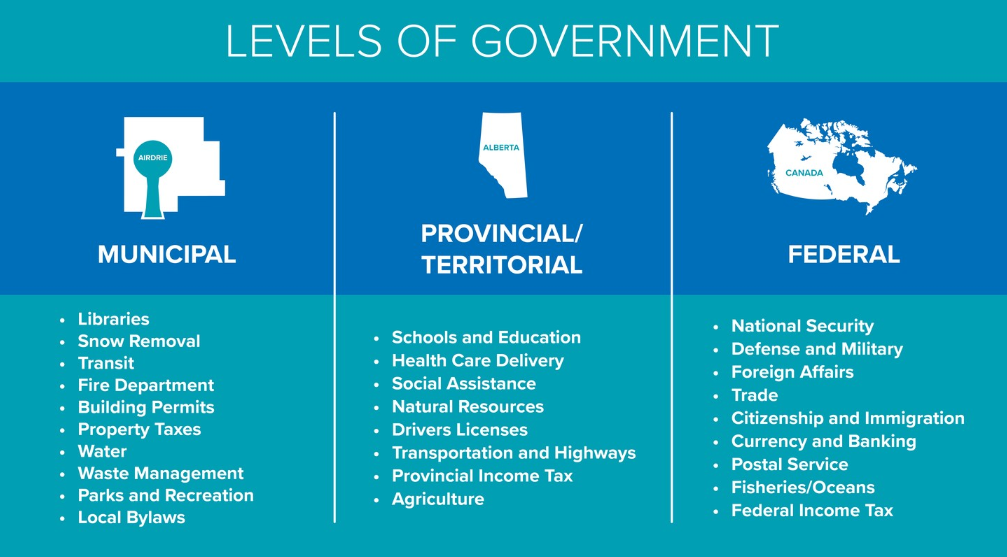
Levels of Government
Federal Government
Handles national matters that affect the entire country of Canada.
Provincial Government
Manages regional mandates and public services within each province.
Municipal Government
Manages local cities, towns, and villages through local councils.
Each level has its own list (formally known as a mandate or jurisdiction) of what they are responsible for.
Concurrency & Cooperation
Some responsibilities, such as immigration and healthcare, require cooperation between federal and provincial governments. For example, while the Canada Health Act sets national healthcare standards through the federal government, the provinces administer its services.
Oftentimes, governments will have to work together on certain issues. One example is the COVID-19 pandemic, which required collaboration from all levels of government on public health measures, vaccine distribution, and providing economic support.
The Federal Government
The federal government was created under the Constitution Act, 1867, and later, the Constitution Act, 1982. Those documents outline the powers and responsibilities of both the federal and provincial governments. The federal government in particular was created to be more powerful than the provincial level.
Responsibilities
The federal government is the national government of Canada. They are responsible for matters that affect the country as a whole.
Areas of federal responsibility include:
- Legislation: Enacts laws on matters of national importance, such as defense, immigration, criminal justice, and trade.
- Defense and Security: Responsible for national defense, the military, and national security.
- Foreign Affairs: Manages Canada’s international relations, including diplomacy, trade agreements, and international aid.
- Economic Policy: Develops and implements policies to promote economic growth, including federal budgets, taxation, and regulation of trade and commerce.
- Social Services: Provides social programs like employment insurance, old age security, and health transfers to provinces.
- Environmental Policy: Regulates environmental protection and conservation efforts, addressing issues like climate change and natural resource management.
Suggested Image: Parliament Hill / Parliament Buildings
(Click “Add Media” to replace this box)
Structure
Canada is a constitutional monarchy, with the British monarch serving as the ceremonial head of state. The monarch’s representative in Canada is the Governor General, who performs various formal duties and acts as a check on powers.
Under the monarchy are the three branches of government: executive, legislative, and judicial. All branches are completely independent of each other.
Elections
Canadian federal elections are held on a fixed date every four years on the third Monday in October. However, an election can be called earlier if the Prime Minister requests the Governor General to dissolve Parliament. This can happen if the government loses a confidence vote in the House of Commons or if the Prime Minister decides to seek a new mandate from the electorate.
The last federal election was held on April 28, 2025, after Prime Minister Mark Carney advised the Governor General to dissolve Parliament. The next scheduled election would be in October 2029, unless an earlier election is called.
Voting & Electoral Districts
Canada is divided into 343 electoral districts (also known as constituencies or ridings). Each district elects one Member of Parliament (MP) to the House of Commons.
On election day, eligible voters in each riding go to their designated polling stations to cast their ballots for their local MP. The candidate with the most votes in each riding wins, even if they do not have a majority of the total votes. This means that someone with less than 50% of the total votes can be elected.
The leader of the party with the most MPs elected becomes the Prime Minister, serving as the leader of the country.
Crown Corporations
Crown corporations are organizations that are owned and controlled by the government. They are structured like private organizations but fulfil an essential role in the public sector.
Examples of Federal Crown Agencies:
- Bank of Canada
- Canada Post
- CBC
- Royal Canadian Mint
- Via Rail
Provincial Governments
Each province in Canada has its own legislature or provincial government, typically referred to as the Legislative Assembly (in Quebec, it is called the National Assembly). Their power is rooted in the Constitution Act, 1867, which grants them responsibility to manage local affairs (jurisdiction). However, provincial powers and responsibilities have grown since the Constitution Act.
Areas of Provincial Responsibility
- Appointing provincial lieutenant-governors
- Appointing judges of superior, district, and county courts
- Social assistance
- Healthcare
- Property and civil rights
- Municipal institutions
- Direct taxation
- Public education
Suggested Image: Provincial Legislature / Queen’s Park
(Click “Add Media” to replace this box)
Composition
The Lieutenant Governor represents the monarch or British Crown in the province. Their role is primarily ceremonial.
Members of the Provincial Legislatures are called Members of the Legislative Assembly (MLAs). In Ontario, they are referred to as Members of Provincial Parliament (MPPs), and in Quebec, they are Members of the National Assembly (MNAs). They are elected during provincial elections when they win the most votes in their riding.
The Premier is the head of the provincial government. They are the leader of the party who holds the most seats in the legislature. The premier also selects among the elected members of the legislature to form a cabinet, who oversees various government agencies and departments.
Provincial Legislative Process
Each province has its own legislative assembly that follows a process to create and pass laws:
|
1. First Reading
Bill is introduced to the legislature; title and general purpose are read out without debate. |
| 🡻 |
|
2. Second Reading
Members debate the bill’s principle and overall purpose, followed by a vote. |
| 🡻 |
|
3. Committee Stage
Bill is examined in detail by a legislative committee. Members may hear expert testimony and propose amendments. |
| 🡻 |
|
4. Report Stage
Committee reports the bill back to the full legislature. Additional amendments can be proposed and debated. |
| 🡻 |
|
5. Third Reading
Final version of the bill is debated and voted on. |
| 🡻 |
|
6. Royal Assent
If passed, the bill is sent to the Lieutenant Governor for formal approval to become official law. |
Provincial Elections
Provincial elections determine the members of provincial legislative assemblies. An election is called by the Premier requesting the Lieutenant Governor to dissolve the legislature. Elections are typically held every four years, though they can be called earlier.
Political parties select candidates to run in each electoral district (ridings or constituencies), alongside independent candidates. The campaign period lasts between 28 to 36 days.
On Election Day, eligible voters cast secret ballots for one candidate in their district. The candidate with the most votes in each district wins a seat. The party that wins the most seats typically forms the government (majority if over half the seats, or minority if supported by other parties).
The process completes when candidates are sworn in as MPPs (Ontario), MLAs (British Columbia), or MNAs (Quebec).
Provincial Agencies
Provincial agencies, boards, or commissions are organizations created to perform specific functions at an arm’s length from government. They cover key services including health, education, and transportation under specific enabling legislation. They are held accountable through appointed boards, annual reports, and audits by oversight bodies like the Auditor General.
Agencies in Ontario undertake four roles:
1. Advisory: Provide advice on specific policies (e.g., Ontario Human Rights Commission).
2. Operational: Deliver services and programs (e.g., LCBO, OLG).
3. Regulatory: Enforce laws and regulations (e.g., Ontario Securities Commission).
4. Adjudicative: Resolve disputes and render decisions (e.g., Landlord and Tenant Board).
Examples of Provincial Agencies in Ontario:
- Ontario Health: Coordinates health care services, hospitals, and long-term care.
- Metrolinx: Integrates transportation across the GTHA (GO Transit, PRESTO).
- Ontario Power Generation (OPG): Generates clean and renewable electricity.
- Ontario Clean Water Agency (OCWA): Provides water/wastewater services to municipalities.
- Ontario Energy Board (OEB): Regulates natural gas and electricity sectors.
- Workplace Safety and Insurance Board (WSIB): Administers workplace injury compensation.
- Ontario Arts Council (OAC): Grants support to artists and arts organizations.
Municipal Governments
Municipalities are divided into cities, towns, or villages based on size and demographics. Provincial governments create municipal governments through legislation, typically titled the Municipal Act, which outlines their powers and duties. Municipalities fund operations through property taxes and user fees (e.g., parking fines).
Municipal Government Services
- Maintenance of local roads
- Public transit
- Planning, zoning & development
- Public health
- Tax collection
- Sidewalks
- Snow removal
- Arts and culture
- Electric utilities
- Fire services
- By-law enforcement
- Water and sewage
- Property assessments
- Library services
- Parks and Recreation
Composition & Leadership
Municipalities are led by a Municipal Council composed of a Mayor and Councilors.
Role of the Mayor:
- Preside over council meetings and represent the municipality
- Provide leadership and recommend bylaws/resolutions
- Establish standing committees and appoint members
Role of City Councilors:
- Act as public representatives and policymakers
- Maintain financial integrity and manage municipal services
- Head committees or act as liaison to community groups
Suggested Image: City Hall / City Council Chamber
(Click “Add Media” to replace this box)
Municipal Elections
Municipal elections take place every four years (e.g., the fourth Monday of October in Ontario). Mayors are elected at large by all municipal voters, while councilors are elected either at large (top overall candidates represent the entire municipality) or by wards (candidates represent smaller geographical sections).
Unlike federal or provincial elections, municipal candidates typically run as independents rather than representing political parties.
Candidate Qualifications
- Resident, non-resident owner, or tenant (or spouse of owner/tenant) in the municipality
- At least 18 years old and a Canadian citizen
- Not legally prohibited or disqualified from holding office
- Can provide 25 nomination signatures
- Able to pay nomination fee ($100 for Councilor, $200 for Mayor)
Voter Qualifications & Registration
Eligible voters must be:
- At least 18 years old on election day
- A Canadian citizen
- A resident, owner, tenant, or spouse of an owner/tenant in the municipality
Municipalities maintain voters lists based on property data. Unlisted eligible residents can apply to be added through the municipal clerk with proper identification.