The Supreme Law of Canada
The constitution is the supreme law of the country (as stated in Section 52 of the Constitution Act of 1982) that establishes the framework of government and defines its powers and limits. The drafters of the constitution designed it to ensure a strong federal government while also respecting provincial autonomy. Any law inconsistent with the Constitution is not applicable.
The constitution includes both written documents and unwritten conventions that draw heavily on British and American influences. Specifically, it blends the parliamentary traditions of the United Kingdom with the federalism structure adopted by the United States.
Key Components of the Constitution
Canada’s Constitution consists of:
Division of Powers & Structure
Patriation, Rights & Charter
Practices & Customs
1. The Constitution Act, 1867
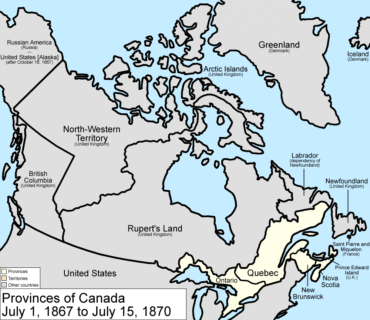
Formerly known as the British North America Act, 1867, this act created the Dominion of Canada by uniting Ontario, Quebec, New Brunswick, and Nova Scotia. It established the federal system, which divides government powers between federal and provincial levels (academically referred to as the ‘Division of Powers’). Accordingly, it set out federal and provincial jurisdictions and powers under Sections 91 and 92.
The act also outlined and defined the structure of Parliament to consist of the House of Commons, the Senate, and the judiciary.
| Structure of Parliament (Established in 1867) | ||
|---|---|---|
| House of Commons | The Senate | The Judiciary |
2. The Constitution Act, 1982
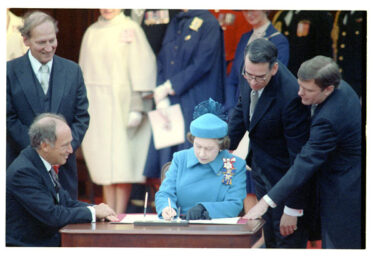
This is historically recognizable for its picture of former Prime Minister Pierre Trudeau and Queen Elizabeth II. More specifically, this act patriated the Constitution and made Canada fully independent from the United Kingdom.
The Constitution Act of 1982 also recognized Aboriginal and treaty rights under Section 35, including that of First Nations, Inuit, and Métis. The section reflects reconciliation efforts between the Canadian government and Indigenous peoples. It is meant to protect Indigenous rights by addressing historical wrongs and guide future interpretations to advance reconciliation.
General Amending Formula
Additionally, the act introduced an amending formula, which outlines how the Constitution can be changed. The general amending formula currently requires the approval of:
(representing 50% of the Canadian population)
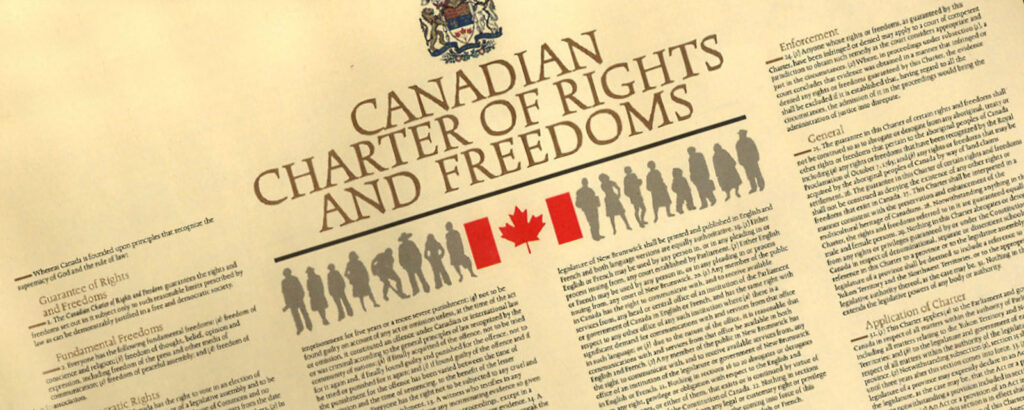
Finally, the act introduced the Canadian Charter of Rights and Freedoms. Often referred to as the Charter, the document guarantees civil and political rights and freedoms for all Canadians against government infringement. The Charter applies to federal, provincial and territorial governments across Canada.
3. Unwritten Conventions
Unwritten conventions are widely accepted historical practices and customs that are fundamental to Canadian governance and part of the constitutional framework, even though they are not formally written in the law or the Constitution. Inherited from the British, these conventions fill gaps in formal legal structures to allow for smooth governance. Conventions are not enforceable in court but are politically binding. Meaning, breaking them can lead to political crises or loss of confidence in government.
An example of a convention relates to the role of the Governor General. While the Governor General acts as the Queen’s representative to formally hold and exercise executive power, they typically do so on the advice of the Prime Minister and Cabinet by convention. This includes when to dissolve Parliament and who to appoint as Cabinet ministers.