
Role of the Governor General and the Crown
The Crown
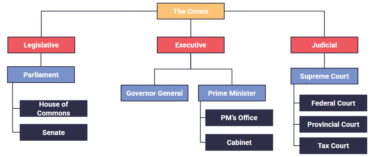
The Crown (King/Queen) plays a symbolic role within the Canadian parliamentary system. They are part of both the legislative and executive branches:
- Executive Branch: Serves as Canada’s official head of state, which is largely a ceremonial role.
- Legislative Branch: Gives the royal assent to bills, which is the final stage in the process of passing bills.
The Governor General
The Governor General is the representative of the Crown within the government and acts on behalf of the Crown.
- Royal Assent: They give the royal assent to bills since the Crown is not in Canada.
- Jurisdiction: The Crown is represented federally by the Governor General and provincially by lieutenant governors.
- Appointment: Appointed by the Crown on advice from the Prime Minister, but in practice, the Prime Minister chooses the Governor General.
Process: How Bills Become Law
Bill is drafted, debated, voted on, and passed in the lower chamber.
Bill undergoes a “sober second thought,” committee review, and final approval in the upper chamber.
The Governor General signs the bill on behalf of the Crown to make it official Canadian law.
Structure of Parliament
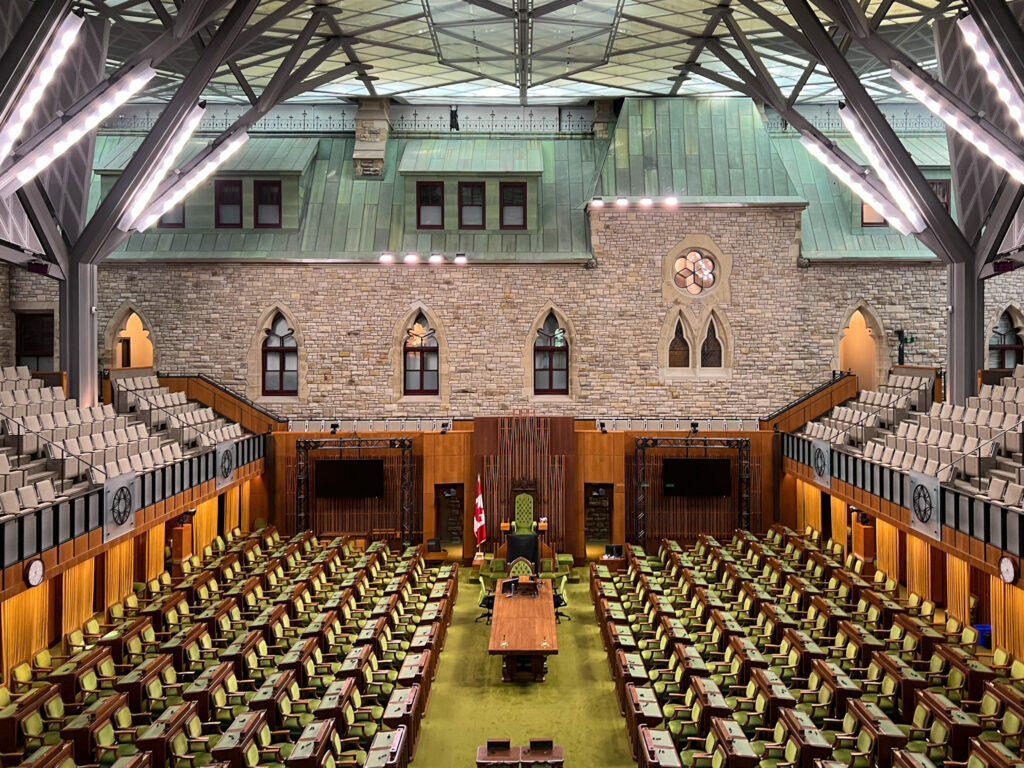
The House of Commons and Senate are a part of the legislative branch. Together, they form the bicameral legislature, meaning there are two chambers.
1. House of Commons
The House of Commons is the lower chamber of Parliament and the predominant forum for political debate and lawmaking. The sitting members hold the government accountable through debates, Question Period, and committee work. The House of Commons decides on the budget for spending, outlining how taxpayers’ money is spent.
Members who sit in the House of Commons are referred to as Members of Parliament (MPs). Currently, there are 343 MPs, each elected to represent one federal electoral district or riding across the country to represent constituents’ interests and concerns and hold the government accountable.
2. Senate
The Senate is referred to as the upper chamber of Parliament that provides a “sober second thought” to the House of Commons. They ensure that laws are fair, reasonable, and regionally inclusive.
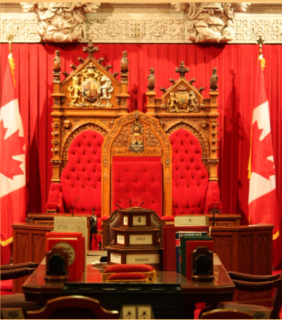
Senators are appointed by the Governor General on the advice of the Prime Minister. Currently, there are 105 Senators, all of whom can serve until the mandatory retirement age of 75 years. Seats are distributed regionally for balanced representation.
Duties Include:
- Reviewing legislation
- Ensuring regional representation, especially for smaller provinces
- Advocating for minority or marginalized communities
Parliamentary Comparison
| Feature | House of Commons | Senate |
|---|---|---|
| Membership | 343 elected MPs | 105 appointed Senators |
| Selection Method | Elected by voters | Appointed by the Governor General |
| Primary Role | Lawmaking and governance | Reviewing and revising laws |
| Accountability | Directly accountable to voters | Not directly accountable |
| Legislation Initiation | Most bills start here | Can start bills here, but usually do not |
The Role of Members of Parliament (MPs) and Senators
1. Members of Parliament & Cabinet
Members sitting in the House of Commons are Members of Parliament (MPs). Currently, there are 343 MPs, each elected to represent one federal electoral district or riding across the country.
Certain MPs are selected to become Ministers in the Prime Minister’s cabinet. As Ministers, these members are responsible for specialized areas such as foreign affairs, finance, or immigration.
Ministers are responsible to the House for any issue or concern their ministry encounters (e.g., backlog in rolling out a program) and set out government priority and policies.
2. Senators
Senators are appointed by the Governor General on the advice of the Prime Minister. In 2016, an Independent Advisory Board for Senate Appointments was created to review candidates. Currently, there are 105 Senators who serve until mandatory retirement at age 75, distributed regionally for balanced representation.
Some duties involve:
- Reviewing legislation
- Ensuring regional representation, especially for smaller provinces
- Advocating for minority or marginalized communities
- Initiating bills (except expenditure of public money or imposing taxes)
Senatorial Qualifications
Section 23 of the Constitution Act 1867
- At least 30 years old
- Canadian citizenship
- Own land in the Province for which they are appointed
- Net worth of at least $4,000
- Resident of the province for which they are appointed
How May a Senator Lose Their Seat?
Section 31 of the Constitution Act 1867
- Does not show up for two consecutive sessions
- Has dual citizenship
- Goes bankrupt or insolvent
- Criminal conviction – treason or felony
- Fails to maintain property or residence qualification
Parliamentary Privilege
Parliamentary Privilege is a constitutional doctrine as indicated by s.18 of the Constitution Act of 1867. It consists of rights that are necessary to ensure the functioning of the legislature and applies to both the House of Commons and Senate, federally and provincially.
Bundle of Rights & Privileges Include:
- Freedom of Speech
- Power to control its own internal proceedings, including internal discipline
- Bodies have legal exemption from some duty, burden, attendance, or liability to which citizens are subject
Application of Parliamentary Privilege
1. Freedom of Speech
- Complete immunity from prosecution or civil liability for things said during parliament sittings and committees.
- Applies to sitting debates on bills and parliamentary committee witnesses/members.
- Ensures complete and free debate without fear of legal precautions.
2. Freedom from Arrest
- Applies only to civil matters — members cannot be arrested or subject to arrest 40 days before/after a parliamentary session and dissolution.
3. Freedom from Obstruction, Interference & Intimidation
- Cannot block members from entering the parliamentary district.
4. Exemption from Court Attendance
- Cannot be served with any legal process on parliamentary grounds without approval from the Speaker.